
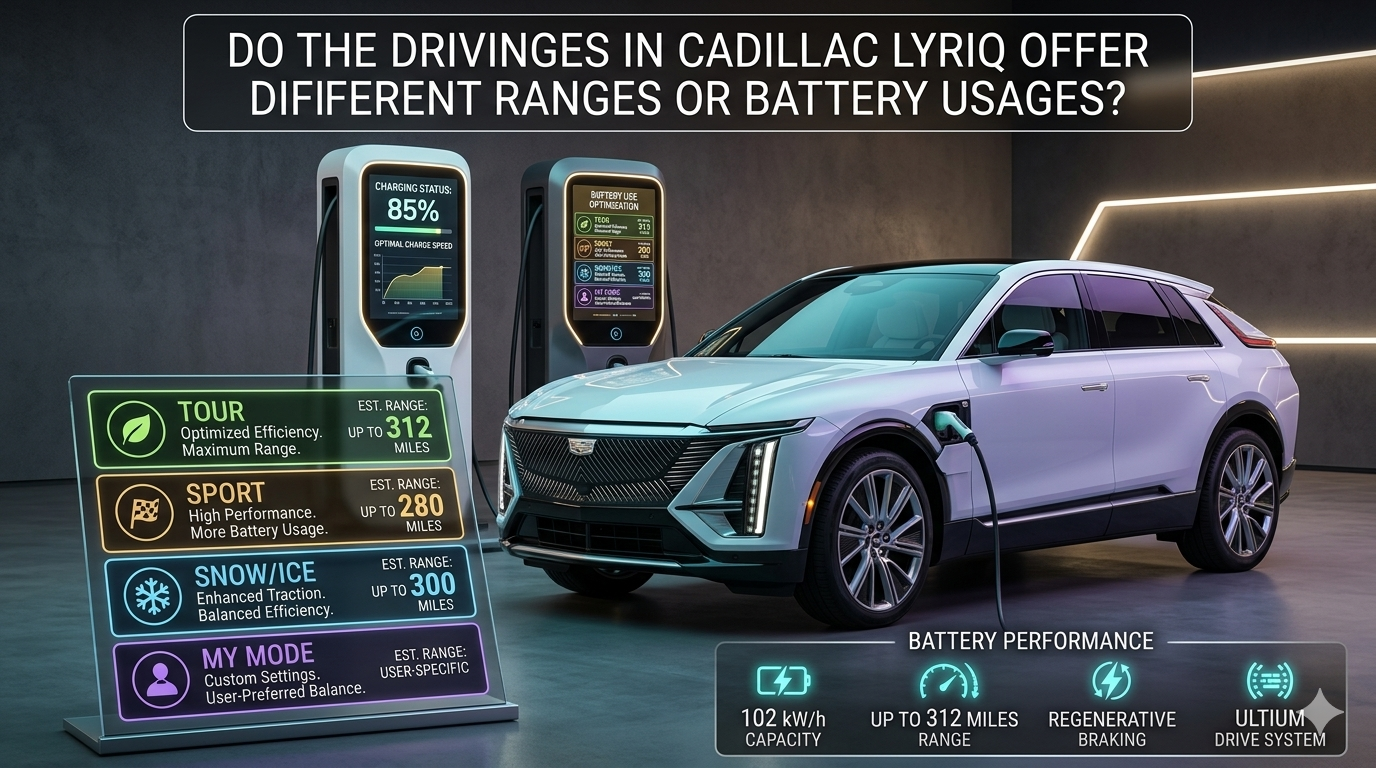
The Cadillac LYRIQ represents a major milestone in Cadillac’s transition toward premium electric mobility. Built on General Motors’ Ultium battery platform, the luxury SUV combines modern styling, advanced technology, and competitive electric range. One of the most discussed topics among EV buyers is whether the driving modes in Cadillac LYRIQ offer different ranges or battery usages.
The short answer is yes. Different driving modes can influence energy consumption, throttle sensitivity, regenerative braking behavior, climate control intensity, and overall battery efficiency. While the modes do not physically change battery capacity, they significantly affect how quickly energy is used during driving. Understanding these differences helps drivers maximize range and improve daily efficiency.
This detailed guide explores every major aspect of LYRIQ driving modes, battery management, real-world range impact, and practical efficiency strategies for owners and future buyers.
Understanding the Cadillac LYRIQ Electric Platform
The Cadillac LYRIQ is powered by GM’s advanced Ultium battery technology, offering smooth acceleration and long-distance capability. Depending on trim and drivetrain configuration, the LYRIQ delivers an EPA-estimated range of over 300 miles on a full charge.
Unlike traditional gasoline vehicles, electric vehicles continuously manage energy through sophisticated software systems. The LYRIQ uses intelligent algorithms to balance acceleration, regenerative braking, cabin comfort, and traction control. Driving modes serve as presets that modify these systems according to driving conditions and user preferences.
Because EV efficiency depends heavily on driving style, speed, terrain, and climate settings, selecting the right mode can noticeably change battery usage. This is why many owners ask: do the driving modes in Cadillac LYRIQ offer different ranges or battery usages? The answer lies in how each mode prioritizes performance versus efficiency.
Cadillac LYRIQ Driving Modes Overview
Cadillac designed the LYRIQ with multiple drive modes to improve adaptability in various conditions. These modes alter several vehicle responses simultaneously.
The main driving modes include:
| Driving Mode | Main Purpose | Effect on Efficiency |
| Tour Mode | Balanced everyday driving | Best overall efficiency |
| Sport Mode | Faster acceleration and responsiveness | Higher battery consumption |
| Snow/Ice Mode | Improved traction in slippery conditions | Moderate energy use |
| My Mode | Personalized settings | Depends on customization |
Each mode changes how power is delivered to the wheels, how aggressively regenerative braking works, and how responsive the accelerator feels. Although these adjustments may seem subtle at first, they can produce measurable range differences over long distances.
How Driving Modes Affect Battery Usage in Electric Vehicles
To understand whether the driving modes in Cadillac LYRIQ offer different ranges or battery usages, it is important to understand EV energy behavior in general.
Electric vehicles consume energy based on torque demand. Aggressive acceleration requires significantly more electricity than smooth driving. Driving modes influence this behavior by adjusting motor response curves. Sport-oriented settings prioritize instant acceleration, while efficiency-focused modes soften throttle inputs and encourage energy conservation.
Climate systems also play a role. Some modes allow more aggressive heating or cooling performance, which increases battery drain. In colder weather, battery efficiency naturally decreases, making driving mode selection even more important.
Because EVs are software-controlled machines, even small adjustments in power delivery can create noticeable differences in real-world driving range.
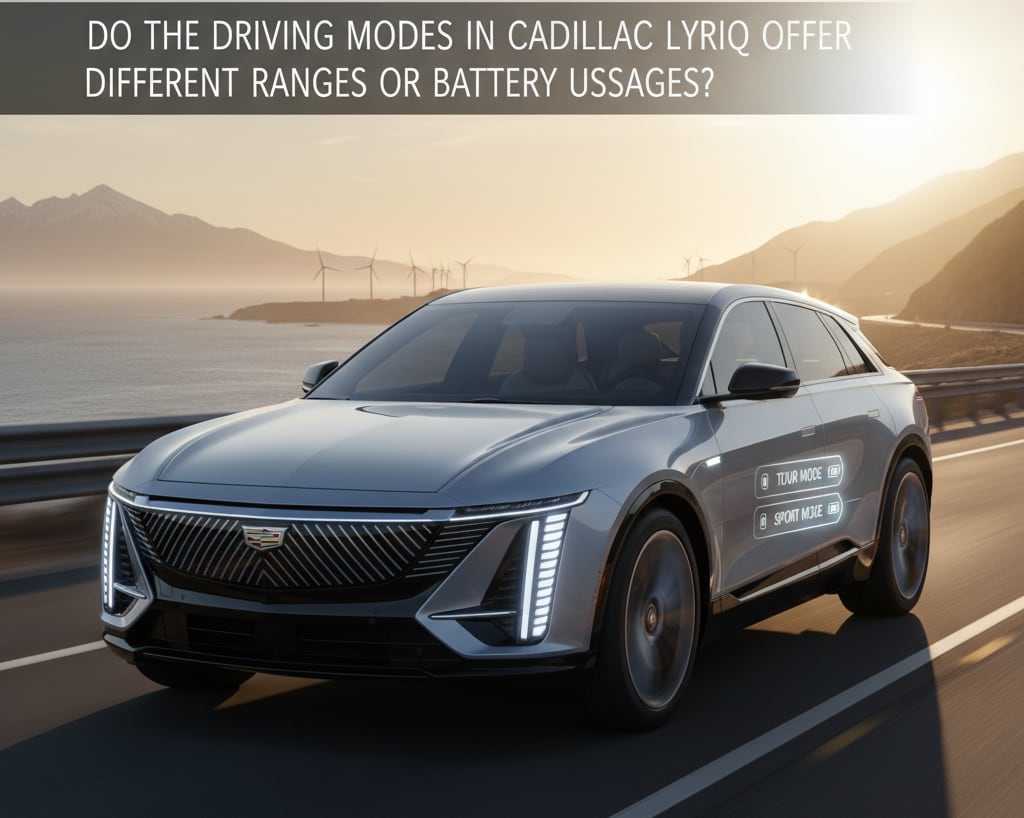
Tour Mode: The Most Efficient Cadillac LYRIQ Setting
Tour Mode is widely considered the most balanced and efficient driving setting in the Cadillac LYRIQ. It is designed for everyday commuting, highway travel, and maximizing battery conservation without sacrificing comfort.
In this mode, throttle response becomes smoother and more predictable. The vehicle accelerates progressively rather than aggressively, helping reduce sudden energy spikes. Regenerative braking is optimized for steady recovery of kinetic energy during deceleration. Climate controls also operate more efficiently compared to performance-focused settings.
Many owners report that Tour Mode delivers the closest experience to official EPA range estimates. Drivers focused on extending battery life during road trips or daily commuting often rely on this mode consistently.
For users wondering if the driving modes in Cadillac LYRIQ offer different ranges or battery usages, Tour Mode demonstrates the clearest efficiency advantage.
Sport Mode and Its Impact on Range
Sport Mode transforms the LYRIQ into a more dynamic luxury EV. Steering becomes firmer, acceleration sharpens, and power delivery becomes more immediate. While this improves driving excitement, it also increases battery consumption.
Electric motors generate instant torque, and Sport Mode takes full advantage of that capability. Rapid acceleration pulls more energy from the battery pack in shorter periods. Frequent use of hard acceleration can noticeably reduce total driving range.
For example, drivers using Sport Mode aggressively in urban traffic may experience lower efficiency compared to Tour Mode. Highway cruising differences may be smaller, but spirited acceleration still affects overall consumption.
Although Sport Mode reduces efficiency, many owners appreciate the enhanced responsiveness and premium driving feel. It highlights how software tuning alone can dramatically influence EV behavior.
Snow/Ice Mode and Battery Efficiency
Snow/Ice Mode is designed primarily for safety and traction control during slippery conditions. This mode reduces wheel spin by softening acceleration and carefully distributing power delivery.
Because the LYRIQ avoids aggressive torque application in Snow/Ice Mode, battery usage can sometimes remain relatively efficient. However, winter temperatures themselves reduce EV range regardless of mode selection. Battery chemistry becomes less efficient in cold conditions, and cabin heating consumes additional electricity.
In snowy climates, Snow/Ice Mode may actually improve practical efficiency because smoother driving reduces unnecessary power loss from slipping tires. Still, environmental conditions remain the dominant factor affecting winter range.
This mode demonstrates that efficiency is not solely determined by performance settings but also by external weather conditions and traction management strategies.
What Is My Mode in Cadillac LYRIQ?
The My Mode feature allows drivers to personalize multiple vehicle characteristics according to their preferences. Users can adjust steering feel, acceleration response, braking sensitivity, and sound enhancements.
Because My Mode is customizable, battery usage depends entirely on chosen settings. Drivers who configure softer acceleration and stronger regenerative braking may achieve efficiency similar to Tour Mode. Conversely, aggressive performance-oriented adjustments can increase energy consumption closer to Sport Mode levels.
This flexibility is valuable because every driver has different priorities. Some prioritize comfort and efficiency, while others prefer a more engaging driving experience. My Mode bridges those preferences by allowing individual optimization.
The customization system reflects Cadillac’s broader strategy of combining luxury personalization with advanced EV technology.
Regenerative Braking and Energy Recovery
One of the most important technologies influencing LYRIQ battery usage is regenerative braking. Unlike traditional vehicles, EVs can recover energy during deceleration and return it to the battery pack.
The Cadillac LYRIQ includes advanced regenerative braking controls, including One-Pedal Driving functionality. This system slows the vehicle aggressively when the accelerator is released, reducing dependence on mechanical brakes while recovering energy.
Driving modes affect how regenerative braking behaves. Tour Mode generally prioritizes balanced energy recovery, while Sport Mode may allow more aggressive acceleration patterns that offset regeneration gains.
Using regenerative braking effectively can significantly improve urban efficiency. Stop-and-go traffic, which wastes fuel in gasoline vehicles, often becomes advantageous in EVs because deceleration energy can be recycled back into the battery
One-Pedal Driving and Range Optimization
The LYRIQ’s One-Pedal Driving feature deserves special attention because it directly affects energy efficiency. This technology enables drivers to accelerate and slow down using only the accelerator pedal in many situations.
When the driver lifts off the pedal, regenerative braking activates automatically. Instead of wasting momentum as heat through brake pads, the system converts motion into electrical energy.
Many experienced EV owners use One-Pedal Driving regularly because it enhances efficiency and smoothness. It can also reduce driver fatigue in urban traffic. Combined with Tour Mode, One-Pedal Driving often provides the best practical strategy for maximizing range.
Although the recovered energy is not enough to fully recharge the battery, it meaningfully extends driving efficiency during everyday use.
Does Climate Control Change Battery Usage?
Climate control is another major factor affecting EV efficiency. Heating and air conditioning systems consume electricity directly from the battery pack.
In colder climates, cabin heating can noticeably reduce range because electric heaters require substantial energy. Air conditioning also impacts battery usage during extremely hot weather, though usually less dramatically than heating.
Driving modes sometimes influence how aggressively climate systems operate. Efficiency-focused settings may optimize temperature control to reduce unnecessary battery drain.
Drivers seeking maximum range should precondition the vehicle while plugged into a charger. This allows the cabin and battery to reach optimal temperatures without using stored driving energy.
Real-World Range Differences Between Modes
While official EPA figures provide general estimates, real-world driving tells a more practical story. Owners often report noticeable differences in range depending on driving mode selection and behavior.
For example, a driver using Tour Mode with smooth acceleration may achieve over 300 miles of range under favorable conditions. The same vehicle driven aggressively in Sport Mode may lose a meaningful percentage of efficiency.
Factors affecting these differences include:
- Speed and acceleration habits
- Outside temperature
- Tire pressure
- Terrain and elevation
- Passenger and cargo weight
- Climate control usage
The driving modes themselves do not magically create or remove battery capacity. Instead, they influence how efficiently energy is consumed during operation.
Highway Driving vs City Driving Efficiency
The Cadillac LYRIQ behaves differently in urban environments compared to highway travel. City driving often benefits EV efficiency because regenerative braking recovers energy during frequent stops.
On highways, sustained high speeds increase aerodynamic drag dramatically. Even in Tour Mode, driving at 75–80 mph consumes more energy than moderate-speed commuting. Sport Mode intensifies this effect because drivers are more likely to accelerate aggressively.
Interestingly, EVs sometimes outperform gasoline vehicles in cities but lose efficiency faster at very high speeds. This makes mode selection especially important for long-distance highway travel.
Drivers planning road trips often use Tour Mode specifically to preserve battery reserves between charging stations
Battery Health and Long-Term Efficiency
Some drivers worry that aggressive driving modes could permanently damage battery health. Fortunately, the LYRIQ includes advanced thermal management systems that protect battery longevity.
While Sport Mode increases energy consumption, occasional spirited driving does not significantly harm the battery. However, repeated high-power acceleration generates more heat, which can contribute to gradual long-term wear over many years.
Cadillac’s battery management software actively monitors temperature and charging conditions to maintain durability. Following healthy EV habits remains important, including avoiding excessive fast charging and maintaining moderate charging levels for daily use.
Battery longevity depends more on charging patterns and environmental exposure than occasional mode selection.
How Cadillac Compares to Tesla and Other EV Brands
Many buyers compare the Cadillac LYRIQ with competitors like the Tesla Model Y, Audi Q8 e-tron, and BMW iX. Driving mode functionality exists across nearly all premium EVs, but Cadillac emphasizes luxury refinement over extreme performance tuning.
Tesla vehicles also offer efficiency and performance modes, though Cadillac’s approach feels more comfort-oriented. The LYRIQ prioritizes smooth transitions and quiet operation, while still delivering strong acceleration when needed.
Compared to some rivals, the LYRIQ’s Tour Mode is particularly refined for daily commuting. Drivers focused on luxury comfort may appreciate Cadillac’s balanced tuning philosophy.
The question “do the driving modes in Cadillac LYRIQ offer different ranges or battery usages” applies similarly across the EV market, as software-based efficiency management is now standard in modern electric vehicles.
Tips to Maximize Cadillac LYRIQ Range
Owners looking to improve efficiency can adopt several practical strategies. Small adjustments often produce meaningful range improvements over time.
Best Practices for Better EV Efficiency
- Use Tour Mode for regular driving
- Enable One-Pedal Driving when possible
- Avoid excessive rapid acceleration
- Maintain proper tire pressure
- Precondition the cabin while charging
- Limit high-speed highway driving
- Reduce unnecessary cargo weight
These habits work together with the LYRIQ’s intelligent software systems to improve battery performance. Consistency matters more than occasional optimization.
Charging Habits and Energy Consumption
Charging behavior also influences long-term efficiency and battery usability. The LYRIQ supports both Level 2 AC charging and DC fast charging for road trips.
Frequent fast charging is convenient but generates additional heat compared to slower charging methods. Many EV experts recommend daily charging between 20% and 80% for optimal battery longevity.
Efficient driving modes complement healthy charging practices. Drivers who combine smooth acceleration with moderate charging habits often experience the best overall ownership satisfaction.
The LYRIQ’s charging software also helps optimize battery conditioning during long-distance travel.
Software Updates and Future Efficiency Improvements
Modern EVs continue evolving through software updates. Cadillac periodically releases updates that refine energy management, infotainment systems, and driving performance.
Future software improvements could further optimize regenerative braking behavior or enhance efficiency algorithms. This means LYRIQ range performance may improve over time without physical hardware changes.
Software-defined vehicles represent a major shift in automotive engineering. Unlike traditional cars, EVs can gain functionality and efficiency through digital updates.
Owners should regularly install official updates to ensure optimal battery management and system reliability.
Common Myths About EV Driving Modes
Several misconceptions exist regarding EV drive modes and battery behavior. One common myth is that Sport Mode permanently harms battery capacity. In reality, modern thermal systems protect the battery effectively.
Another myth is that efficiency modes drastically increase total range instantly. While Tour Mode improves consumption, real-world results still depend heavily on driving conditions and habits.
Some drivers also assume regenerative braking can fully recharge the battery during driving. Regeneration helps recover energy but cannot replace charging entirely.
Understanding these realities helps owners make informed decisions about efficiency and driving enjoyment.
Why Driving Modes Matter for Everyday Owners
Driving modes may appear to be simple convenience features, but they meaningfully shape the ownership experience. They allow the LYRIQ to adapt between luxury comfort, sporty responsiveness, and winter safety with minimal effort.
For commuters, Tour Mode delivers smooth and efficient daily transportation. Enthusiasts can enjoy Sport Mode during spirited driving. Drivers in colder regions benefit from Snow/Ice traction assistance.
This adaptability reflects the growing sophistication of electric vehicles. Instead of relying solely on mechanical engineering, modern EVs use software intelligence to tailor performance dynamically.
That flexibility is one of the reasons the Cadillac LYRIQ stands out in the premium electric SUV market.
Conclusion
So, do the driving modes in Cadillac LYRIQ offer different ranges or battery usages? The answer is clearly yes. Whi
le the modes do not change the physical battery capacity, they directly influence how efficiently energy is consumed through acceleration response, regenerative braking, traction management, and climate system behavior.
Tour Mode generally provides the best overall efficiency and longest practical range, making it ideal for commuting and road trips. Sport Mode prioritizes responsiveness and performance at the expense of increased battery consumption. Snow/Ice Mode improves winter traction while balancing energy use in cold conditions. Meanwhile, My Mode allows personalized tuning based on driver preferences.
Combined with regenerative braking, One-Pedal Driving, and smart charging habits, these modes help drivers tailor the Cadillac LYRIQ experience to their specific needs. As EV technology continues evolving, intelligent driving modes will remain an essential part of maximizing efficiency, comfort, and performance.
Frequently Asked Questions (FAQs)
1. Does Sport Mode reduce Cadillac LYRIQ range?
Yes. Sport Mode increases acceleration responsiveness and power delivery, which typically leads to higher battery consumption and reduced driving range.
2. Which Cadillac LYRIQ mode is best for efficiency?
Tour Mode is generally considered the most efficient mode for maximizing battery range and smooth daily driving.
3. Does One-Pedal Driving improve battery usage?
Yes. One-Pedal Driving increases regenerative braking effectiveness, helping recover energy during deceleration and improving efficiency.
4. Can driving modes damage the LYRIQ battery?
No. Cadillac designed the battery management system to safely handle different driving modes without causing immediate battery damage.
5. Does cold weather affect LYRIQ battery range?
Yes. Cold temperatures reduce battery efficiency and increase heating demands, lowering overall driving range.
6. Is Snow/Ice Mode more efficient than Sport Mode?
Usually yes. Snow/Ice Mode limits aggressive power delivery, which can help reduce unnecessary energy consumption in slippery conditions.
7. Do software updates improve LYRIQ efficiency?
They can. Cadillac software updates may refine energy management systems, regenerative braking behavior, and overall efficiency performance.